
Have you ever stood in a massive festival crowd and felt the sub bass shake your chest? That explosive energy is no accident—it comes from a specific set of studio skills designed to make music sound giant. If you want to take your music from your bedroom to the main stage, mastering Festival Trap Production Techniques is your ultimate golden ticket. Creating these massive anthems requires a perfect mix of smart sound selection, aggressive layering, and energetic arrangement choices. Let us dive into the core studio secrets that will make your drops hit like a sledgehammer and get your tracks ready for the biggest sound systems in the world.
Why Does Festival Trap Sound So Powerful?
This genre sounds massive because it fuses two worlds. It takes the heavy, rolling sub bass and snappy hi-hats of regular trap music. Then, it mixes them with the huge, wide synth leads and massive room reverb of big room house music.
The magic comes from contrast. The verses feel wide and open. When the drop hits, all the energy focuses into a clean, hard-hitting kick drum and a giant laser-like lead sound. This contrast creates an explosion of energy that forces crowds to dance.
Top 10 Festival Trap Production Techniques
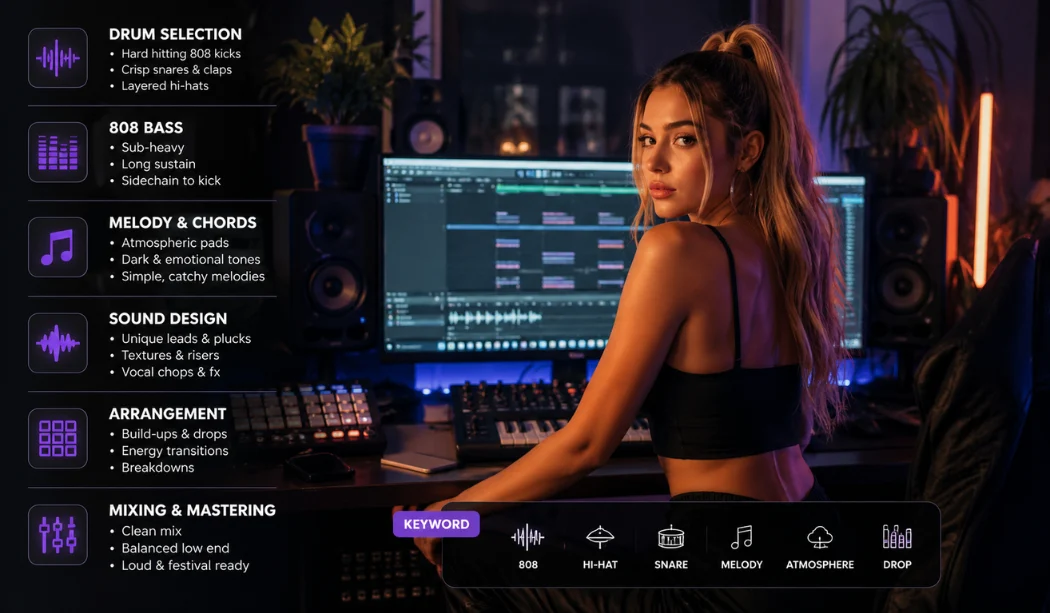
To get that mainstage sound, you need to use specific tricks in your digital audio workstation (DAW). These best festival trap production techniques will take your songs from flat to professional.
1. High-Quality Sound Selection
Great tracks start with great sounds. Use festival trap sound selection tips like picking short, punchy kick drums and bright, wide claps. If your base sounds are weak, no amount of mixing will save them.
2. The Art of Mega Layering
Never rely on just one synth for your main melody. Create a thick wall of sound by stacking different instruments together. A good festival trap synth layering tutorial always suggests using three layers: a bright top layer, a wide middle layer, and a gritty bottom layer.
3. Creating Premium Brass Screams
That signature festival horn sound is iconic. For great festival trap brass sound design, take a standard orchestral brass sample and link it with a synthesizer saw wave. Add heavy distortion and a fast pitch-bend at the start of each note to make it scream.
4. Splitting Your Sub Bass Harmonics
A big sub bass can disappear on small speakers or phones. To fix this, duplicate your 808 track. Keep the first track clean and low. On the second track, cut out the low frequencies and add a saturation send to create upper harmonics. Now your bass sounds huge everywhere.
5. Aggressive Sidechain Compression
Your kick drum needs to punch through everything. Use a compressor to quickly lower the volume of your synths and bass every time the kick plays. This leaves a clean pocket of space for the punch of the drum.
6. Stereo Width Management
Keep your sub bass and kick drum perfectly in the center (mono). Push your main synths, claps, and sound effects out to the far left and right sides. This makes your mix feel incredibly wide and three-dimensional.
7. Pitch-Rising Build-Ups
Create tension before the drop by slowly shifting the pitch of your synths and drums upward. A rising pitch tells the human brain that something exciting is about to happen.
8. Sudden Volume Automation
Right before the drop hits, drop the volume of your whole track down by 1 or 2 decibels for a split second. When the drop plays at full volume, the sudden jump makes the music feel twice as powerful.
9. Smart Reverb Cuts
Big festival tracks use a lot of reverb to sound like they are playing in a giant stadium. However, too much reverb makes a mix muddy. Use an automation curve to cut off the reverb tail right when the kick drum hits to keep things clean.
10. Crisp Transient Shaping
Use a transient shaper plugin on your drums. Boost the initial attack to make your snares and kicks cut through thick walls of synthesizers easily.
Advanced Festival Trap Production Techniques
Once you know the basics, you can try advanced festival trap production techniques to stand out. One major secret is micro-editing your audio files. Cut tiny gaps of complete silence right before your main snare hits. This silence cleans the listener's ears and makes the next beat smash even harder.
Another expert trick involves using festival trap drop automation tricks. Instead of keeping your synths wide all the time, automate your stereo width plugin. Make the music narrow during the build-up, then open it up to 100% width exactly on the first beat of the drop.
How to Make a Festival Trap Drop?
Building a massive drop is all about managing energy and using festival trap drop impact techniques. Follow these steps to build an explosive peak section:
- The Pre-Drop Fill: Leave a 1-bar or 2-bar gap between your build-up and your drop. Fill this space with a funny vocal sample or a unique drum roll.
- The Main Kick: Use a heavy kick drum with a lot of high-end click so it cuts through the music.
- The Rolling 808: Program your bass to roll smoothly under the melody, changing pitches to match the chords.
- The Laser Lead: Play a simple, catchy melody using your stacked synth layers.
What is the Secret to Professional Festival Trap Mixes?
The biggest secret to professional festival trap mixing techniques is keeping the mix simple. Even though the music sounds giant, there are rarely more than four elements playing at the exact same time.
"The biggest mistake young producers make is adding too many instruments. In a festival environment, less is always more. Clean, loud, and simple beats will always win over messy, complex ones." — Alex Vance, Mainstage Audio Engineer
To get a festival trap festival ready mix tips, make sure your kick and 808 bass are the loudest things in your DAW. Your main lead synth should sit just below them. Keep everything else in the background.
Festival Trap Production Techniques for Beginners
If you are just starting, do not get overwhelmed by fancy plugins. Use festival trap production techniques for beginners to build your confidence first:
- Download a high-quality, free sample pack for trap music.
- Write a simple four-bar melody using a basic saw-wave synth.
- Practice matching your kick drum hits perfectly with the start of your 808 bass notes.
Focus on clean timing and basic volume balance before moving on to complex sound routing.
Summary Table of Key Production Elements
| Production Element | Main Goal | Best Tool to Use |
| Sub Bass (808) | Deep chest punch | Saturation & Mono placement |
| Lead Synthesizer | Bright main melody | Multi-layering & Wide stereo |
| Kick Drum | Driving rhythm | Sidechain compression & Attack boost |
| Build-Up Section | Maximum tension | Pitch risers & Volume automation |
Frequently Asked Questions
What BPM is best for festival trap?
Most tracks in this genre sit comfortably between 140 BPM and 150 BPM. This tempo allows for double-time hi-hat rolls while keeping a heavy, stomping half-time groove.
How do I stop my 808 from sounding muddy?
Always use a high-pass filter on your synths and vocals to cut out any low-end frequencies below 100Hz. This leaves the basement of your track completely open for the 808.
Should I use real brass or synth brass?
The best festival trap sound design secrets combine both! Layer a real orchestral brass sample for natural texture, then back it up with a heavy synthesizer saw wave for modern power.